The Temple of Forgiveness
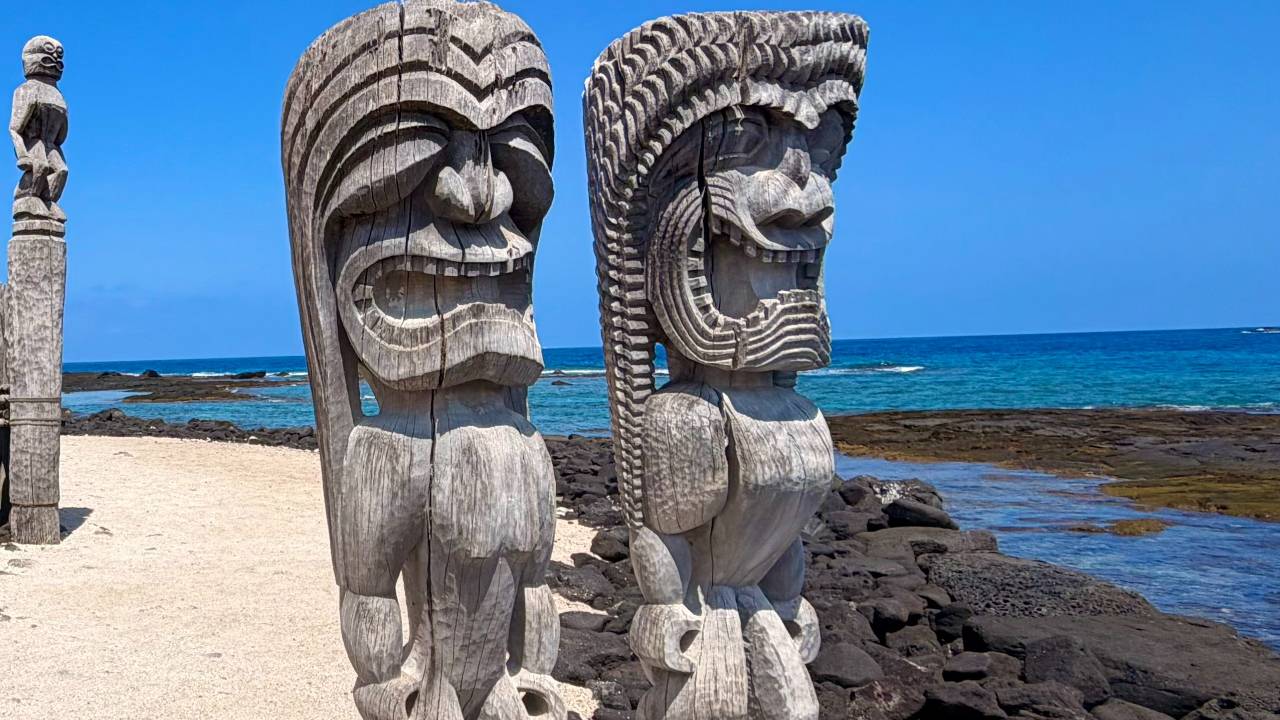
On the Big Island of Hawai'i, there is an ancient temple in South Kona called Puʻuhonua o Hōnaunau, translated as the temple of forgiveness, or Place of Refuge.
No matter what you had done in that society, whatever terrible thing you had committed, however deep the trouble you’d found yourself in, if you could get yourself into the temple of forgiveness, you would be forgiven and sent back.
But this meant taking a journey first and it was not an easy one.
To reach the temple gate, you might have had to run miles across sharp, black lava rock. You might have had to swim across the open ocean, a crossing that could take days, the odds against you the whole way.
There was no turning back, no way to return to who you were before, to the old life. The only way through, was to meet it, fully. And still, you kept going. You had to. Behind you was everything you were forced to let go of.
Ahead of you, beyond the pain of the past, was the only place healing could be found.
Only those who refused to give up hope, no matter what they’d been through, ever made it to the temple gates.
Most of us will never have to cross the open ocean to survive. But we know this journey in other forms, and the strength it asks of us. The devastating end of a relationship or marriage. An illness we did not choose. The sudden loss of a livelihood. The loss of someone we loved, or a beloved pet. Or something larger and more collective, grief for a world at war, for a planet in crisis, for a future that feels uncertain, a crossing that can feel like it has no shore in sight.
The terrain may have changed. But the crossing is the same one people have always had to make.
Self-forgiveness, then, is not a single act, but a journey, much like the one to that ancient temple by the sea. The refuge we are seeking, however, was never truly outside of us. The shore of peace and freedom we’re looking for is already here, waiting. It is not always an easy path to walk. But we have been given the practices, and the path forward, to find our way to it, learning to meet our own heart and body as the temple of forgiveness.
The Practice of Liberation
As I was preparing this teaching on forgiveness, I found myself reflecting on the essence of mindfulness meditation, that at its heart, it’s a practice of liberation.
And to be truly free, we cannot hold onto our suffering, especially suffering rooted in the past. All our attachment to old pain keeps us from knowing true peace, happiness and freedom in the present moment.
The truth I come back to when forgiveness of myself or others feels difficult is, I cannot be in the present moment if I am caught in the past. Holding onto past mistakes prevents me from fully experiencing the present moment.
There is real dignity, even nobility, in this, the courage to finally forgive, and come home to the peace that was always ours to claim. This is a brave act.
There is a close association between self-compassion and forgiveness. Forgiveness is essential in life, because we make mistakes all the time, out of our own unskillfulness.
We Have All Been Wounded and We Have All Wounded Others
“We all carry within us our places of exile, our crimes, our ravages. Our task is not to unleash them on the world. It is to transform them in ourselves and others.” -Albert Camus
We have all, at some point, made mistakes out of our own unskillfulness, knowingly and unknowingly. We have all been betrayed; we have self-abandoned. No one is exempt from this. We make mistakes, and in our unskillfulness we cause suffering. We have all been wounded and we have all wounded others. Often to the people we love most, but perhaps most quietly, to ourselves.
Zen Master Thích Nhất Hạnh taught that forgiveness becomes possible when we can see the suffering underneath someone’s actions, recognizing that, more often than not, they were not truly trying to cause harm. They were unskillful, without the capacity to carry the weight of their own pain and woundedness.
This same seeing is what we are asked to offer ourselves today. When we were unskillful, when we caused harm we didn’t intend, we too were often simply unable to hold the pain of what we were carrying in that moment.
This doesn’t change the impact of what happened. But if we can recognize this, if we can meet our own unskillfulness the same way we’d meet a dear friend’s, it can soften the hold the past has on us, and open a door toward genuinely forgiving ourselves.
Coming Home
“If you want to see the brave, look to see those who can return love for hatred. If you want to see the heroic, look to those who can forgive.” -The Bhagavad Gita
There is real dignity, even nobility, in this, not in never having caused harm, but in being willing, still, to turn toward ourselves and others with honesty, compassion and find our way to forgiveness.
There is a deep understanding on the Bodhisattva path, the path of awakening beings that can be helpful to hold in awareness, that the suffering we naturally encounter is itself a gateway to compassion. When we can meet that rawness, that pain of what’s arising, with courage and a tender presence, real compassion begins to blossom. Its fullness arises from the truth of how fully we’re willing to connect, how fully we’re willing to contact what’s actually here.
Our habitual conditioning, when we come near that rawness, is to tighten and pull away. And yet, we’re also conditioned to hold tightly to our stories, to the pain we call suffering, unwilling to let it go.
Compassion and self-forgiveness practice deconditions this response, which only causes us more suffering. And teaches us to soften, to open, and to be willing to touch our own vulnerability and hurt, without aversion to our own suffering, or grasping tighter to our story.
What Forgiveness Is and Isn’t
Forgiveness does not mean that you condone what happened. It doesn’t mean “forgive and forget.” You may find it necessary to stand up, speak up and prevent something from happening again. You may make the inner determination to prevent this suffering from continuing, for me, or for anyone else.
This is why the common misconception, that forgiveness is weakness, or that it means ignoring what happened, is simply incorrect. Forgiveness isn’t condoning harm. It’s saying: I will not let this happen again. I will do what’s necessary to prevent this suffering again.
And it’s important to say, forgiveness doesn’t mean you need to keep any relationship in your life, especially if someone is unsafe or harmful for you. All of this can be done in a way that protects both yourself and others.
Why Forgiveness Matters
So why is forgiveness valuable? As Tara Brach has spoken of, forgiveness releases us and releases the world around us, from the grip of anger, hatred, hurt, and fear. It shifts us, as human beings, out of that primitive, fear-based place, and allows us to rest instead in the wisdom of the wise heart, to see with kind eyes of compassion. It allows us to move from a kind of inner exile back into connection, and trust, with this world.
So how do we forgive ourselves, when we cause pain, knowingly or unknowingly, to ourselves and others?
Ram Dass offered the image of polishing the mirror of the heart, returning to it again and again, so that it stays clear enough to reflect love rather than resentment. He taught that our task is simply to keep working on ourselves, so that we might become instruments of compassion and loving awareness.
It is necessary preparation for offering compassion and healing to others. By reducing our own inner pain and resentment, by tending to that mirror, we become more present, and more genuinely useful in helping others carry theirs. Inner transformation, in this way, is the foundation for easing suffering in the wider world.
When we ask who forgiveness is really for, we start to understand: it’s primarily for ourselves. You do it for the sake of your own heart, and your own well-being, and your own freedom.
We begin by keeping our hearts open to our own remorse, rather than deflecting it with anger or self-justification. From there, we can respond to ourselves with compassion, in word and in deed, asking simply: what is it that hurts most? And meeting that place with kindness, rather than causing ourselves further harm. It is here, in this breath, in this body, in this willingness to turn toward our own heart instead of away from it.
This is the work of our practice, using self-forgiveness and loving-kindness, to offer ourselves the same refuge once offered at the gates of that old temple.
And so now, in this practice, let your body be a temple of forgiveness.
Mindfulness Practice
If it feels right for you, I invite you to reflect for a moment and turn your attention inward.
Allow yourself to sit comfortably, and let the mind settle into stillness.
Feel the breath. Breathe gently and naturally, and bring your attention to the area of the heart as you breathe. Feel the gentle rising and falling, like waves of the ocean.
Begin by scanning the landscape of your experience right now, today, the last hour. Simply sensing if there’s anything present that wants compassionate attention. It might be something immediate, or it might be something ongoing in your life, a layer of your being that’s quietly asking for compassion. Perhaps there’s a feeling of hurt, fear or sorrow.
Reflection Prompts:
-
What is keeping you from the shore of peace? Whether it’s peace with yourself, or peace with someone else?
-
When you don’t forgive, what is that like for you? How does it feel to carry that? What does it feel like in your body, in your nervous system?
-
You may ask yourself: who is it for? Who, in that moment, is actually suffering?
-
Why is self-forgiveness so much harder than forgiving others, and what keeps us from reaching its essence?